Posts

Showing posts with the label propaganda

The Meaning of the Nakba

Image
Anti-Zionist protesters have a lot to complain about. In the seven months since the October 7 massacre, over 35,000 Gazans have been killed, compared to less than 2,000 Israelis. Population centers in Gaza have been decimated, while Israel has been able to fend off most of the missiles fired into the Jewish state.  Around two million Gazans have been displaced, compared to perhaps 250,000 Israelis.   These numbers are impossible to ignore, but they do not tell the whole story. For critics of Zionism, the current Israel-Gaza war is just the latest chapter in the ongoing Palestinian struggle against the state of Israel. This struggle, which they call  the Nakba ( "the Catastrophe"), began in the late 19th century, when Zionists staked a claim to the land in Palestine as their national home, and crystallised during the first Arab-Israel war (1947-1949), when Israel ascended to statehood and over 700,000 Palestinian Arabs became refugees, mostly in Gaza and the West Bank....
Thoughts on South Africa and Israel's first appearances before the ICJ

South Africa's strongest case seems to be that Israel has not done enough to crack down on hate speech and possible incitements to genocide within the country. While Israel has taken some steps in this direction, the ICJ may decide that they have not done enough. A plausible outcome would be a provision recommending that they do more. As for South Africa's argument that Israel's military activities should be suspended until a verdict is reached: I think the case is extremely weak, and the ICJ is almost certain to reject it. On the one hand, South Africa ignores the many efforts Israel has made to protect innocent Palestinian lives and comply with the Genocide Convention. Second, South Africa fails to take into account the fact that Hamas continues to be an active participant in hostilities, and that hostages and other Israeli civilians are still in danger--hundreds of thousands of whom have already been displaced. South Africa's argument is ideologically driven, which t...

Does Hamas = ISIS? Unravelling More Anti-Zionist Propaganda

Image
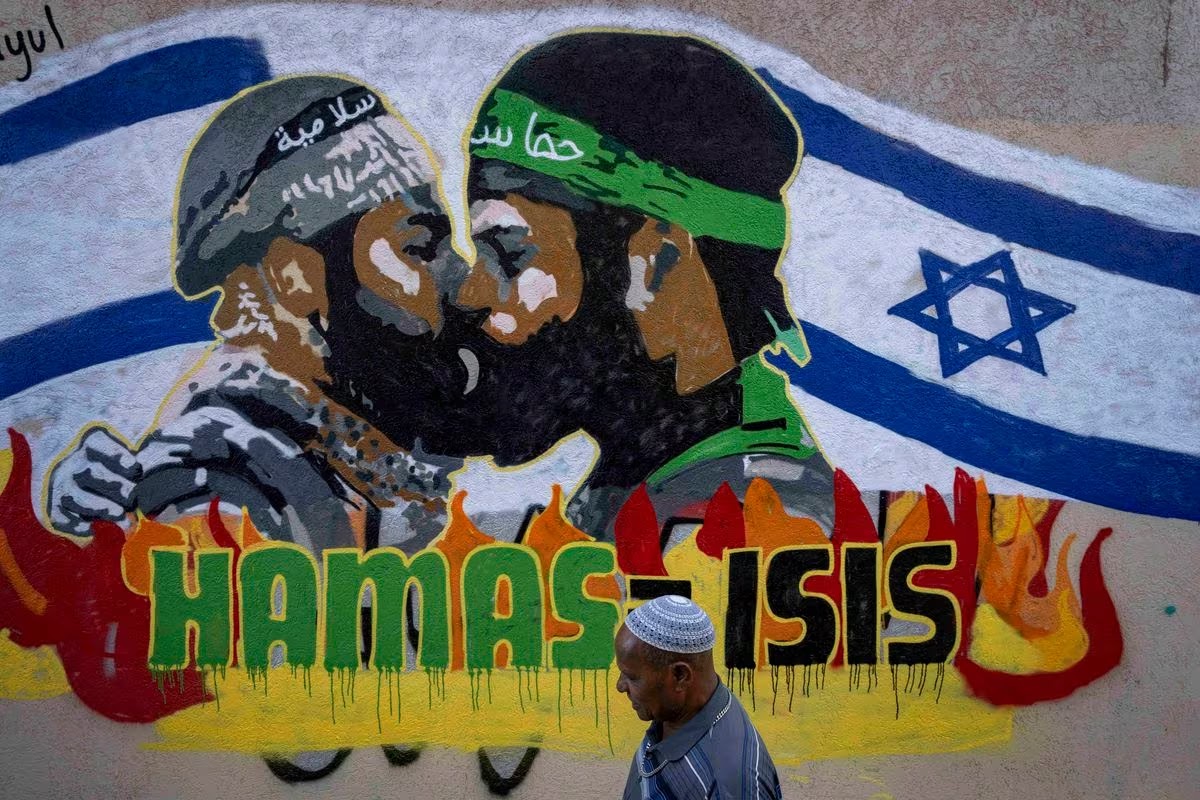
Does Hamas = ISIS? What does that slogan even mean? Certainly ISIS and Hamas are distinguishable. I don't think anyone is saying that Hamas and ISIS are the same organization, with the same leaders, the same members, or even the exact same ideas. It seems obvious that "Hamas=ISIS" only means that their goals and practices are *similar enough* so that we should treat them the same. On that topic, I encourage you to read this analysis from The Conversation . It provides a good overview of similarities and differences between the two terrorist organisations, if you want to make up your own mind on the topic. It is certainly much more useful than  this opinion piece by Monica Marks , which I believe is representative of the pro-Palestinian movement. My suspicion is that its publication in Time was not based on the merits of its argument, but rather because of the anti-Israel rhetoric it propagates. The inadequacy of Marks' argument is plain as day. While she admits that ...

Defending Zionism: An Open Letter To Jason Stanley

Image
Professor Jason Stanley. Photo taken from   https://campuspress.yale.edu/jasonstanley/ Approximately a month after Hamas attacked Israel on Oct. 7, 2023, instigating the ongoing Israel-Gaza war, the Guardian published an opinion piece by Jason Stanley , the Jacob Urowsky Professor of Philosophy at Yale University, entitled, "My Life Has Been Defined By Genocide of Jewish People. I Look On Gaza With Concern." Though I had not had any interaction with Professor Stanley in a number of years, I felt inclined to share my immediate reaction with him. After all, we had enjoyed some acquaintance in the past, primarily spawned by my criticisms of his philosophical approach to know-how and his take on Gilbert Ryle. Unfortunately, our heated exchanges over the 2016 Democratic primary led us to lose contact. (Incidentally, I decided to break off contact first, though he might have been considering doing the same.) Unsurprisingly, he did not respond to my initial thoughts on his recent Gu...

TED Talks: Rhetoric And Dialectic

The more I look, the more I find evidence that TED is propaganda .  It uses factually misleading yet emotionally persuasive and motivational speeches to sell the idea that creative geniuses are changing the world for the better.  It sells itself as a conveyor of knowledge and as access to the world of the intellectual elite.  Here is how TED presents itself  (the bold is from their own Website): TED conferences bring together the world's most fascinating thinkers and doers, who are challenged to give the talk of their lives (in 18 minutes or less). On TED.com, we make the best talks and performances from TED and partners available to the world, for free. . . . Our mission: Spreading ideas. We believe passionately in the power of ideas to change attitudes, lives and, ultimately, the world. So we're building a clearinghouse of free knowledge from the world's most inspired thinkers, and also a community of curious souls to engage with ideas and each other. It'...

TED Talks: Deb Roy's "The Birth Of A Word"

Image
I've recently voiced the thesis that TED Talks  are aimed at pseudo-intellectuals and promote a pseudo-intellectual culture.  They do not inform so much as they persuade people into following a cult of personality.  I'm not saying they aren't informative at all. They can be, but I think the information is generally misleading and at the expense of a particular, emotionally-driven agenda.  However, I have not seen a majority of the many, many TED talks that are out there.  I don't want to jump to any conclusions, so I'm only offering this idea as a hypothesis.  To make a stronger argument about TED Talks in general, a lot more Talks would have to be analyzed.  (It is also important to look at how TED Talks are planned, organized and promoted, but I'll save that for another day). I know some people who claim to watch TED Talks because they offer a brief, entertaining glimpse into the future of science and technology.  I question how accurate that ...

Learning From History: Interpreting Godwin's Law

Godwin's Law seems as old as the Internet itself.  It's the principle that, given enough time, any online discussion will inevitably lead to some mention of Hitler or the Nazis.  Today, however, some people take Godwin's statement as a prescription:  Don't mention Hitler or Nazis in an online discussion (unless you're discussing something specifically to do with Hitler and the Nazis). I recall once, a year or two ago, I made a comparison between Ayn Rand and the Nazis on a friend's Facebook wall.  I think the analogy was that Ayn Rand is to capitalism what the Nazis were to nationalism.  My point, which I made explicitly clear, was that you cannot criticize capitalism by criticizing Ayn Rand, just as you cannot criticize nationalism by criticizing the Nazis.  (Edit: Actually, I think I phrased it this way:  Defending capitalism by defending Ayn Rand is like defending nationalism by defending the Nazis.  But the point is the same.)  I think ...

TED Propaganda and Pseudo-Intellectualism

Image
Author Thomas Frank has written a critical commentary on TED and the literature of creativity.  His thesis is that the literature and TED are engaging in propaganda, selling their audience (identified as the professional-managerial class) the false idea that their own creativity is the source of their financial success and power.  I'm not convinced by Frank's argument, but I think there is something true in what he is saying.  However, I also think he gets something very wrong. I've been thinking a lot about propaganda lately, since I'm currently teaching it as part of my IB English: Language and Literature course.  In my class, we focus on Nazi propaganda (especially an extract from chapter three of  Mein Kampf ) and Walt Disney war propaganda cartoons from 1943, such as "Reason and Emotion." As I explain to my students, the  Mein Kampf extract   and "Reason and Emotion" used many of the same rhetorical strategies (flattery and ridicule, in p...